
Impressions may not always align.
What seems clear in one area can create doubts or difficulties in another.
WORKPLACE CLIMATE
Listen to your team’s experience.
Identify what to protect and what needs to change.
Build a shared picture of how people experience work,
set priorities and agree what to improve.
THE STARTING POINT.
From a managerial perspective, one sees only a part of the picture. Each team experiences things differently: how information flows, what happens when seeking help, or how decisions are explained.
Workplace Climate brings these perspectives together and transforms them into a useful resource for maintaining what works and deciding what needs improvement.
What seems clear in one area can create doubts or difficulties in another.
Discussions often revolve around communication or collaboration, but it's difficult to pinpoint where the friction arises.
Participation requires feedback: what has been understood and what will be done next.
LISTENING AND INTERPRETATION
We listen to how the work is experienced and review which practices and situations help to understand it. This allows us to connect both perspectives before proposing changes.
TEAM EXPERIENCE
We gather perceptions about relationships, communication, support, and daily organisation. We look for both difficulties and practices that are worth preserving.
What is valued, what causes friction, and what needs attention.
ORGANISATIONAL CONTEXT
We review recent changes, coordination methods, and the conditions of the area being analysed. We identify shared patterns, differences, and issues that require further investigation.
What practices help to explain the experience and can be reviewed?
A perception represents an experience. Participation, differences in context, and the quality of the information are important when deciding which conclusions can be drawn.
A synthesis helps to focus, but it can obscure different experiences. We review which voices are represented, which topics are repeated, and what differences can be interpreted using the available information.
The breakdowns are useful when they make sense and allow for protection. If the participation is insufficient or a group is identifiable, the conclusion or presentation of that detail is limited.
WHERE TO FOCUS ATTENTION
These areas guide the initial conversation. We select the ones that make sense for your organisation and agree on how to explore them.
The areas are adapted to the project. The tools, sources, and method of presenting information are determined before starting.
WHAT YOU RECEIVE
Synthesis, priorities, and agreements to move forward. Explore the deliverables through an example of coordination between departments.
FICTIONAL EXAMPLE · COORDINATION BETWEEN DEPARTMENTS
In two areas that work together, changes in one request may not reach all the involved people.
There is a willingness to collaborate when the information is clear and up-to-date.
The method for communicating changes and who needs to be informed to continue the work.
A professional summary explains the key topics, highlights that should be prioritised, and areas that require attention. The reading incorporates the context and limitations of the information gathered.
A common starting point for more precise discussion.
Let's talk about your projectFictional example to explain the service. The content, target audience, level of detail, and feedback are all specified in the proposal.
HOW WE WORK.
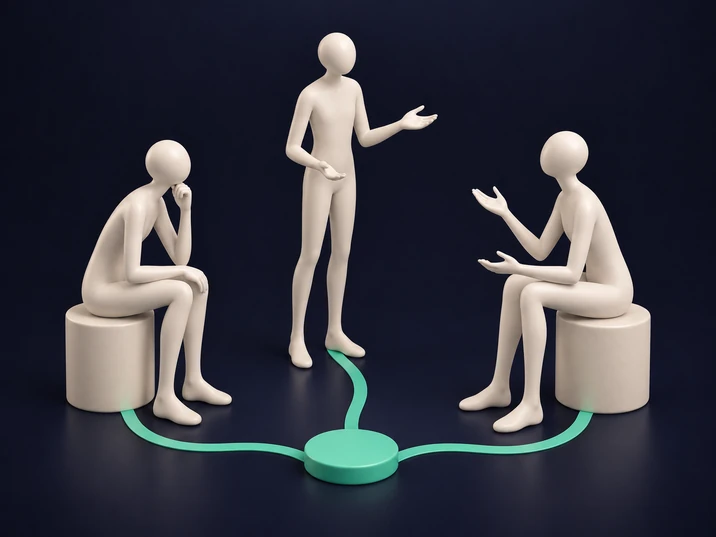
Value emerges when the team's experience is understood, shared, and used to inform decisions. Each phase prepares for the next.
We agree on the need, the scope of work, the participants, and the decisions the project should help prepare. We specify tools, deliverables, and a timeline.
We explain why we are gathering information, how people can take part and how their responses will be used. Before collecting responses, we agree who can see the findings, how responses will be grouped and how feedback will be shared.
Gather the information through the agreed-upon methods and review participation, shared topics, and interpretable differences. Compare what is necessary before drawing conclusions.
Present a clear summary and work on strengths and areas for improvement. We agree on what will be communicated to the team and what decisions can be made.
The plan includes actions, responsible parties, and review criteria. Execution, working sessions, and new measurements are included when they are part of the contracted scope.
FROM UNDERSTANDING TO AGREEMENT – AN ILLUSTRATIVE EXAMPLE
In a fictional organisation, two departments collaborate on the same requests. Versions change and are not always communicated to everyone. Active listening helps move from a general impression to a concrete agreement.
Identify when information is lost and who needs it to continue.
Define where a request is updated, who updates it, and who needs to be notified.
Explain the agreement and check with the relevant departments to see if it resolves the issue or requires adjustments.
Fictional example, without customer responses or results. Illustrates how to guide an improvement; it does not present a real conclusion or a universal solution.
WHAT DOES IT OFFER YOUR ORGANISATION
When you need to understand how work is carried out, beyond isolated conversations or management impressions.
An organised review of what needs to be taken care of and reviewed.
When coordination tensions, organisational changes, or needs that are not experienced equally across all teams arise.
Priorities linked to specific daily situations.
When you want a question to be accompanied by a response and understandable commitments.
A plan to explain what will be done, who is responsible, and how it will be reviewed.
THE CONDITIONS FOR EFFECTIVE LISTENING
People need to know what they are participating in, who will receive the information, and how it will be used. Explaining these conditions is part of the project design.
The feedback process is also prepared from the beginning: what we have understood, what we will prioritise, and what commitments the organisation can make.
Address any questions or concerns that arise during the process.Objectives, activities, and participation requirements clearly explained, with a channel for addressing questions.
Agreed-upon access and groupings. We pay attention to details, comments, and small groups that may identify solutions.
Understandable conclusions, priorities explained, and agreements on who will take responsibility for each action and how it will be reviewed.
COMPLEMENTARY PERSPECTIVES
Workplace Climate has its own scope. When needed, it can be connected to other organisational resources without requiring a full service package.
BEFORE WE BEGIN
Scope, participation, deliverables, and tracking.
How is the work environment experienced within the organisation: relationships, communication, support, recognition, coordination, and other relevant aspects for the project. It gathers perceptions and interprets them within context to identify strengths, priorities, and areas for improvement. Specific areas are selected according to need.
Workplace Climate focuses on the everyday experience of the work environment. Cultural DNA helps to understand the values and cultural criteria that guide the organisation. They are complementary perspectives, with their own objectives and deliverables; Workplace Climate can be contracted without Cultural DNA.
The proposal defines the appropriate methods: questionnaires, interviews, or focus groups, depending on the objective and scope. Before starting, the tools, participants, and information to be collected are specified. The six sections on this page are editorial guidance, not a fixed set or a reproduction of a questionnaire.
The conditions are explained before participation. We distinguish between anonymity and confidentiality: restricted access does not mean that a response is anonymous. We agree on what information is collected, who can access it, and how it is presented. An anonymous response is only communicated when the design allows for this condition.
Only when participation, available information, and the protection of individuals allow it. The groups and presentation criteria are agreed upon before data is collected. If a group is too small or easily identifiable, it is combined with another appropriate area or presented separately. No individual classifications are published, and no breakdown is promised for any team.
A professional summary of the topics analysed, strengths and priorities, along with an improvement plan and a proposal for feedback. The format, groups, recipients, and sessions are defined in the project. The examples on this page are fictitious and are intended to show how the content can be organised.
This limitation is made clear, and responses are presented in a way that does not imply they represent the entire organisation. Differences are examined in context; a single conclusion is not forced, and silence is not interpreted as satisfaction. It may be necessary to broaden the scope of the inquiry or to refine the question before making a decision.
We define what will be communicated, through which channel, and by whom. The feedback can include the main themes, strengths, priorities, and commitments made, while avoiding details that identify specific responses. It is also important to explain which aspects require further work or will not be addressed at this time.
The plan proposes actions and criteria for review. Workshops, training, support for implementing measures, and a new data collection are incorporated when agreed upon in the proposal. To compare different moments, the scope, participation, and data collection conditions are reviewed.
We start with a conversation about your organisation and what you want to understand. Based on this, we define the scope, participants, method, deliverables, timeline, and investment. The duration depends on this design and the coordination needed to listen, interpret, provide feedback, and agree on priorities.
LET'S TALK ABOUT WORKPLACE CLIMATE
Tell us what you want to hear from your team and which decisions lie ahead.
We’ll design the project and agree the next steps with you.
We will define the scope, participants, tools, deliverables, support, timeline, and investment.